
Lesson Dialogues
There's no videos for this lesson. This was before we started making videos for L1 lessons.
 PDF version is here
1. 今からどこに行くの
子ども:今からどこに行くの?
お父さん:仕事だよ。
子ども:いつ家に帰るの?
お父さん:8時くらいだよ。
子ども:ヨーグルト買ってきてね。
お父さん:ヨーグルトね。いいよ。
子ども:今(いま)からどこに行(い)くの?
お父さん:仕事(しごと)だよ。
子ども:いつ家(いえ)に帰(かえ)るの?
お父さん:8時(じ)くらいだよ。
子ども:ヨーグルト買(か)ってきてね。
お父さん:ヨーグルトね。いいよ。
Child: Where are you going now?
Father: To work.
Child: When will you come home?
Father: Around 8:00 o’clock.
Child: Please buy me some yogurt on your way home.
Father: Yogurt. Got it.
今 いま now
の Emphasises a question
から from
どこ where
行く いく to go
仕事 しごと work; job
よ Announcing new information; emphasises a sentence
いつ when
家 いえ house; home
帰る かえる return; go back; come back;
時 じ o’clock
くらい about; around
ヨーグルト yogurt
買う かう to buy
ね shares information or experiences; soften a sentence; expects an agreement
いいよ got it
2. ドーナツが一番好き
お母さん:ドーナツは二人で一つ食べるよ。
子ども(ハルキ):僕、一人で一つ食べたいな。
お母さん:ハルキくんはドーナツが一番好きって言ってたもんね。
お母さん:ドーナツは二人(ふたり)で一(ひと)つ食(た)べるよ。
子ども(ハルキ):僕(ぼく)、一人(ひとり)で一(ひと)つ食(た)べたいな。
お母さん:ハルキくんはドーナツが一番(いちばん)好(す)きって言(い)ってたもんね。
Mother: The two of you will share a doughnut.
Child (Haruki): I want to eat a whole doughnut myself.
Mother: You did say doughnuts are your favorite thing.
ドーナツ a doughnut
二人 ふたり two people
食べる たべる to eat
一人 ひとり one person; alone
僕 ぼく I (used by male speakers)
食べる たべる to eat
一番 いちばん number one; first; most
好き すき to like; favorite
言う いう to say
3. ボールどこにある?
友達A:ボール、どこにあるか知ってる?
友達B:知ってるよ。
友達A:どこにあるの?
友達B:もう少し上だよ。
友達A:もう少し上?これかな?
友達B:そうだよ。それだよ。
友達A:ボール、どこにあるか知(し)ってる?
友達B:知(し)ってるよ。
友達A:どこにあるの?
友達B:もう少(すこ)し上(うえ)だよ。
友達A:もう少(すこ)し上(うえ)?これかな?
友達B:そうだよ。それだよ。
Friend A: Do you know where the ball is?
Friend B: Yeah, I know.
Friend A: Where is it?
Friend B: It’s a little higher.
Friend A: A little higher? Is this it?
Friend B: Yeah, that’s it.
ボール a ball
知る しる to know
もう少し もうすこし a little; a few
上 うえ top; above; up; on
かな indicates uncertainty; soften a sentence
これ this
それ that
4. ゴリラの手
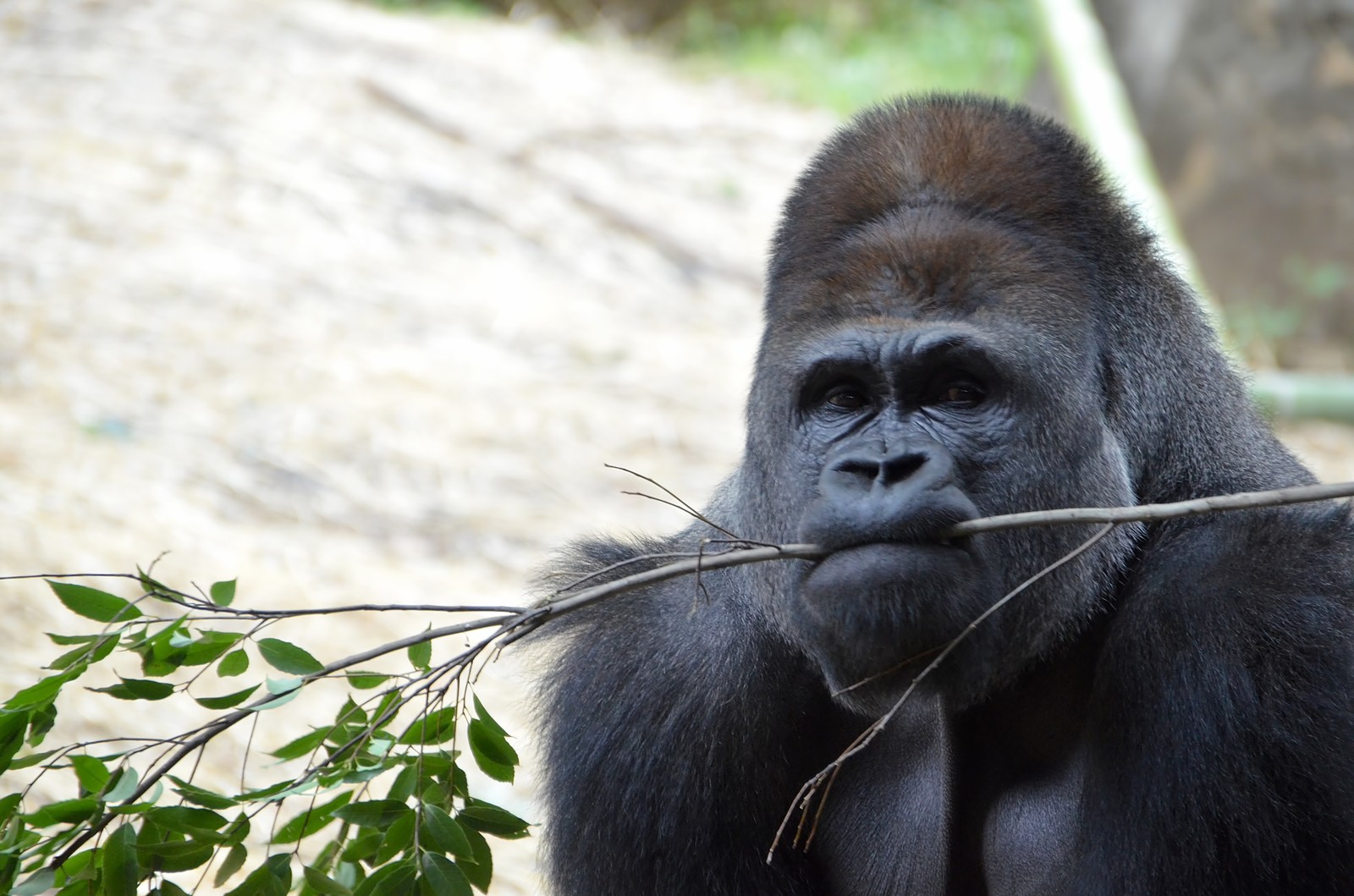
友達A:ゴリラ見た?
友達B:見たよ。
友達A:ゴリラの手って人間みたいだよね。
友達B:そうだね。
友達A:チンパンジーの手もゴリラと人間みたいだよね。
友達B:そうだよね。
友達A:ゴリラ見(み)た?
友達B:見(み)たよ。
友達A:ゴリラの手(て)って人間(にんげん)みたいだよね。
友達B:そうだね。
友達A:チンパンジーの手(て)もゴリラと人間(にんげん)みたいだよね。
友達B:そうだよね。
Friend A: Did you see the gorilla?
Friend B: Yes, I did.
Friend A: The gorilla’s hands looked like human hands.
Friend B: Yeah, they did.
Friend A: The chimpanzee’s hands also looked like gorilla and human hands.
Friend B: Yes, they do.
ゴリラ a gorilla
見る みる to see
手 て a hand
人間 にんげん human; human being; man
みたい like
チンパンジー a chimpanzee
そうだね That's right
よね shares mutual sentiments; confirming something
Step 2 - Take the Quiz
Let's see how many words you remember.
Take the quiz here.
Step 3 - Writing Exercises (Optional)
Let's practice what you learned here.
hello! is this the first lesson we should try after learning the alphabet and work our way to the most recent? thank you:)
Hello. Thank you for reaching out.
You can take any lessons in any order as they are independent.
We also explain how to use the course here:
../../../../how-to-use-the-course/index.html
This course isn’t for beginners, but we have another one that’s perfect for beginners if you are interested.
Hi what is the course for beginners? I have been taking this course even though I am still a beginner lol but I would be interested in doing the other course too:)
Thank you for your inquiry regarding our course. 🙂
We offer a course for beginners called YBJ.
You can find and apply for it on our homepage.
thank you so much!!!
No problem! 😀
ゴリラの手って, why is the a Te behind the Hand. What does it emphasises? Thanks!
Aって here works for presenting a topic like the は particle, which means “A is (adjective)”, “as for A” or “speaking of A”.
ゴリラの手って人間みたいだよね。
ゴリラの手は人間みたいだよね。
– Gorilla hands are like human hands.
– As for Gorilla hands, they are like human hands.
– Speaking of Gorilla hands, they are like human hands.
Hello, another question, this time about で in dialogue 2.
Is this the contextual particle? It doesn’t appear to be to me based on the examples in my book, but that’s the only thing I can find when looking into it.
Also when it comes to pronunciation, 僕 is listed as ぼく but I swear Haruki is saying もく instead. Similarly, が in the last sentence sounds like な. Why is that?
And if I could tack one more thing on to that, what’s the role of もん in the last sentence?
I’ve found って as a particle for “you said” and た as the verb “did,” but I can’t find what もん means (and I assume ね is softening like it is in dialogue 1).
もん is a casual form of もの.
As one of the several usages, it indicates a reason.
The conversation can be translated like this:
Haruki: “(But) I really want to eat it all by myself.”
Mother: You mentioned earlier. Because you like donuts best, right, Haruki?
As for って, it’s a casual form of と. It works to quote what others said in the same way as “that” in English.
ハルキはドーナツが好きだと言った。
ハルキはドーナツが好きって言った。
Halki said that he likes donuts.
Oh I see! Thank you for the great examples 🙂
No problem! ^ ^
Do you mean で as in 一人で and 二人で?
This time it is obvious, but when asking a question, we would appreciate it if you could tell us not only the part you want to know but also the phrase or sentence that includes it.
The particle で also has several usages, and here, it works as limiting numbers or quantities.
一人で means “alone” or “by oneself.”
一人で食べたい means “I want to eat all of it alone.”
二人で means “in a pair,” “together,” “by two people,” depending on the context.
Regarding the pronunciations, the voice actor who played the boy said ぼく (boku), but “b” sound is a bit weaker than normal. I guess her attempt to create a boyish voice might affect her pronunciation.
が is actually pronounced as “nga” instead of “ga.” It’s a nasal sonant. Many announcers and voice actors pronounce the が column that way.
Sorry, I asked very generally because I was having trouble ascertaining what exactly the で belonged to in the sentence.
I see now. So で is both a multifaceted particle and in this case part of an expression that makes 一人 more specific. Thanks!
Thank you as well for the pronunciation clarification. I understand Japanese to be quite phonetic so anything that sounds different than it reads trips me up a bit, as I want to make sure its just a matter of who is speaking and not fundamental pronunciation (as with は).
I didn’t find the bonus/cheat sheets until yesterday, which have already made it easier to answer my own questions. I very much appreciate your patience, はなせんせい!
No worries.
It’s just that Japanese particles function similarly to prepositions in English, having various meanings and usages.
So we need to know a phrase or sentence containing a particle to answer questions.
で as in 一人で works like “by” in English.
> I understand Japanese to be quite phonetic
ー We may subconsciously understand the other person’s words from their grammatical patterns and context, rather than hearing them word for word.
I guess you do the same thing more or less in your native language.
Keep up the good work!
“I didn’t find the bonus/cheat sheets until yesterday” What bonus/cheat sheets are you referring to? Where can I find them?
-Edit-
Oh wait. Never mind. It’s on the homepage under “Quick Links”.
Glad you’ve found them!
Hi, I have a question about 食べたいな from the second sentence of dialogue 2.
I know the negative form of ru-verbs adds ない and the past form involves た, but that doesn’t seem to be quite what’s going on here. That makes sense, since negative past tense isn’t what’s being expressed, but what’s happening with たいな then?
I’m guessing its something to do with how the child wants the doughnut but specifically with how they want it in a different way than proposed (for himself rather than shared).
Thanks! 🙂
First of all, xxxたい works as “want to do xxx” or “would like to do xxx”.
な is a particle that has several usages. Here it serves to express and emphasize a desire.
So, 食べたい means “want to eat.” By adding な, the kid is insisting on it.
That makes sense! I see たい now in my grammar book. Curiously, I can’t seem to find anything in it on using な for insistence, but that’s not too hard to understand 🙂
Thank you!
No problem!
I think it’s because some sites introduce it as なあ instead of な since some people extend the sound of な when they say it.
This is good. I like it. The voices are slow, quite convenient for beginners.
Now, regarding this sentence:
ヨーグルト買ってきてね
I understand that “kite” comes from “kuru”.
Is this a sentence we can replicate with another verbs, suchs as…
KAKU – To write
Kono tegami wo kaite kite ne – Write this letter for me, please?
Is that like that?
Verb TE + Kite ne for asking “do it for me”
Thank you!
(Sorry for romaji, I know how to write Japanese but right now I’m not using my computer. Gomen ne…
> ヨーグルト買ってきてね
I understand that “kite” comes from “kuru”.
ー Yes, the word consists of 買う (buy) and 来る (come).
It means “Get me some yogurt.” (Not only buy them, but bring them to me.)
> Is this a sentence we can replicate with another verbs, suchs as…
KAKU – To write
Kono tegami wo kaite kite ne – Write this letter for me, please?
Is that like that?
Verb TE + Kite ne for asking “do it for me”
ー Not quite. If you’d like to say “Write a letter for me,” you can say 手紙を書いてね。
If you say 手紙を書いてきてね, it means “Write a letter and bring it to me.”
> (Sorry for romaji, I know how to write Japanese but right now I’m not using my computer. Gomen ne…
ー That’s okay. No worries! 🙂
I tried to do some research beforehand about how the sentence ending particle もん/もの is different from から/だから since they both seem to be used for adding a reason but I didn’t really understand anything except that もん is more childish? I don’t fully grasp their differences and why もん was used instead of から in the example sentence so I’d appreciate some help 🙂
We use もん in casual situations.
もんmeans because; indicates reason/ excuse/ dissatisfaction
How to form
Verb (casual) +(んだ)+ もん
Noun + なんだ+ もん
な-adjective + なんだ+もん
い-adjective +(んだ)+ もん
It can be used like the below.
A: なんか嬉しそうね?=You look happy.
B: うん、明日から夏休みだもん。
=Yes. Because my summer vacation will begin tomorrow.
A: どうして食べないの?=Why don’t you eat it?
B: 美味しくないんだもん。=Because it doesn’t taste good.
You can use kara to indicate the reason, too.
もん sounds more casual.
I hope this helps!
In ヨーグルト買(か)ってきてね。where is the please and me. Is it the te form & ね?
ヨーグルト買ってきてね。
We often omit words if the context is clear without saying them.
Yes, てform+ね.
What verb conjugation is みたいだ in Dialogue 4? Why is is used here? It looks like “want to look like” in casual speech. Why is it not 見てる?
みたいだ. Meaning:
like something (Expressing the similarity)
noun + みたいだ
Ex. 犬みたいだ。人間みたいだ。ゴリラみたいだ。
Hope it helps!
What does this part mean?
手って
full sentence: ゴリラの手って人間みたいだよね。
I know 手 is supposed to mean hands, but what about って?
って: about; as for: 名前って何ですか?What’s your name?; in spoken Japanese, people use って very often instead of は: ラーメンって好きですか?Do you like ramen? (instead of ラーメンは好きですか?)
What does this last part mean?…
たもんね
Full sentence:
ハルキくんはドーナツが一番(いちばん)好(す)きって言(い)ってたもんね
~もん indicates as the reasons. ね indicates as confirmations. In this conversation, the mother was confirming the reason why Haruki wanted to eat the doughnut alone.
I should have read the comments first I guess xD
Assets are not being loaded on this lesson, images and the audio files, those are because the links are in http and I am using https, if you could fix the links would be nice 🙂
Not sure why but the video is not loading tho… I could not find any link to video 😛
If I find more broken articles I’ll comment there 🙂
There’s no video in this less. It was before we started making videos.
I’m a little bit confused about the use of “から”. It says it means “from”, but the kid is asking where his dad is going, not where he’s coming from. I’ve been trying to think over how it could make sense but I can’t come up with anything. Would you explain it please? I just want to understand how the word is used.
今から means “from now”. から connects to 今 (now).
Ohh, I see. I thought it was connected to the going part, I should have realized with how the actor said it haha.
Will we be getting audio for Lesson 1 and 2? Same with Level 2 Lesson 1 and 2?
Sorry, lesson #1 and #2 are test lessons. I should remove them because people are confused.