You should add particles for formal settings and writings.
In general, dropping particles is only for spoken Japanese.
However, it’s sometimes OK to drop the particle for polite Japanese when the situation is allowed. That said, speaking to your boss, teacher or doctor, etc, or giving a formal speech or presentation, you should use all particles in the sentence.
Before deciding to drop the particle, you should ask yourself.
“Would this make sense without the particle?” and the situation you stand. If you are not sure whether it is OK to omit particles, it is better to use them.
Basically, は, が, and を are often dropped; に sometimes. か, as a sentence-final question particle, can be replaced with intonation.
Thanks. I know about what you describe, it’s just that in order to be able to drop particles one should first be totally aware of where particles are supposed to be and which ones to use, in the first place.. i.e. learn to intuit Japanese sentence structure (the course does a good job at improving listening ability for sure). So it would be nice to see a hint in the hovering definitions, but that may be tricky – they describe individual words. But maybe “dropped” particles could be shown with the furigana when furigana is enabled? (“えいが[を]みに”)? I don’t know how difficult something like that would be to implement. I’m grateful for the changes done recently, I get much more out of the practice now than before.
Thank you for your feedback! That sounds like a sensible idea!
But please know that I personally think that idea of “dropping” a particle doesn’t always apply when we speak Japanese. We “add” particles when we want to emphasise something or we want the sentence to sound in a particular way.
In this particular case, saying 映画を見に行った would sound fine, but often, either there’s simply no particle we can “add” and still sound like a real person in conversation, or there are multiple particles we can add to have different effects.
It’s not always a simple question of “dropping” the “correct” particle.

 MP3
MP3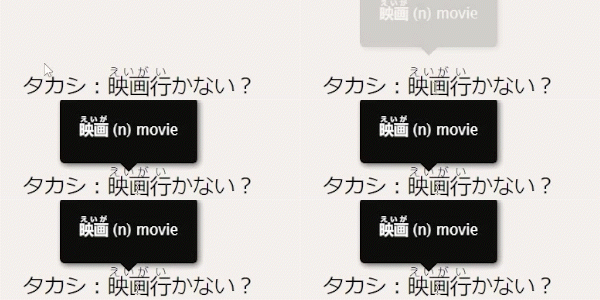
In “俺は映画観に行った”, should there technically be a “を” after 映画 ?
You should add particles for formal settings and writings.
In general, dropping particles is only for spoken Japanese.
However, it’s sometimes OK to drop the particle for polite Japanese when the situation is allowed. That said, speaking to your boss, teacher or doctor, etc, or giving a formal speech or presentation, you should use all particles in the sentence.
Before deciding to drop the particle, you should ask yourself.
“Would this make sense without the particle?” and the situation you stand. If you are not sure whether it is OK to omit particles, it is better to use them.
Basically, は, が, and を are often dropped; に sometimes. か, as a sentence-final question particle, can be replaced with intonation.
Thanks. I know about what you describe, it’s just that in order to be able to drop particles one should first be totally aware of where particles are supposed to be and which ones to use, in the first place.. i.e. learn to intuit Japanese sentence structure (the course does a good job at improving listening ability for sure). So it would be nice to see a hint in the hovering definitions, but that may be tricky – they describe individual words. But maybe “dropped” particles could be shown with the furigana when furigana is enabled? (“えいが[を]みに”)? I don’t know how difficult something like that would be to implement. I’m grateful for the changes done recently, I get much more out of the practice now than before.
Thank you for your feedback! That sounds like a sensible idea!
But please know that I personally think that idea of “dropping” a particle doesn’t always apply when we speak Japanese. We “add” particles when we want to emphasise something or we want the sentence to sound in a particular way.
In this particular case, saying 映画を見に行った would sound fine, but often, either there’s simply no particle we can “add” and still sound like a real person in conversation, or there are multiple particles we can add to have different effects.
It’s not always a simple question of “dropping” the “correct” particle.
[Edited to express my idea better]