
Lesson Dialogues
 MP3
MP3
Download Now
* Hover over or tap words to see definitions: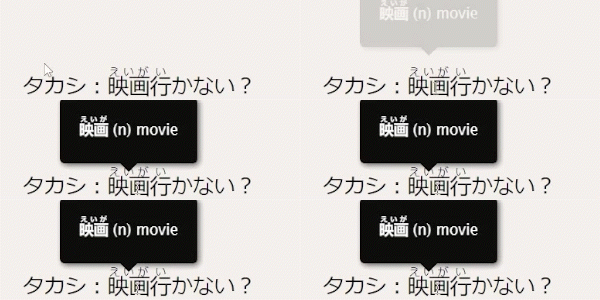
Situation 1
After watching a movie, Yuko is talking with a junior student, Rika.
Comprehension Quiz (Skip if you don't understand the conversation yet)
今日観た映画は、____。
A 面白かった
B 小さかった
C 悪かった
D 新しかった
ユウコ:今日観た映画、どうだった?
リカ:すごい面白かったです。
ユウコ:そうだよね?思ったより全然面白かった。
リカ:観てよかったです。
Situation 2
Sato-san is drinking coffee at the house of a neighbor, Matsui-san.
Comprehension Quiz (Skip if you don't understand the conversation yet)
松井さんは、____お店でコーヒーを買った。
A 新しい
B この前の
C 結構高い
D すぐそこの
佐藤:このコーヒー、美味しいですね。
松井:そうですよね?私もこれ好きで。
佐藤:どこで買ったんですか?
松井:すぐそこのお店ですよ。
Situation 3
Yuri is talking with her boyfriend Kaito.
Comprehension Quiz (Skip if you don't understand the conversation yet)
カイトの目の上に、なんか付いていますか?
A はい
B いいえ
ユリ:なんか付いてるよ。顔に。
カイト:ほんと?顔のどこ?
ユリ:目の上。
カイト:ここ?
ユリ:ううん。もっと上。
カイト:えー、ここ?
ユリ:もうちょっと上。
Situation 4
At school, Hiroto is talking to his classmate Yuko.
Comprehension Quiz (Skip if you don't understand the conversation yet)
ユウコは、行きたい大学がありますか?
A はい
B いいえ
ヒロト:行きたい大学、ある?
ユウコ:ううん。まだ考えてるとこ。
ヒロト:そっか。
ユウコ:ヒロトはあるの?
ヒロト:うん、あるよ。
ユウコ:へー。どの大学?
Step 2 - Take the Quiz
Let's see how many words you remember.
Take the quiz here.
Step 3 - Writing Exercises (Optional)
Let's practice what you learned here.
Thank you so much for your comments and answers! I read all the ones I can find after the lessons, and they really help me understand the little nuances of the language, which makes learning it even more interesting! ありがとうございます。
We’re glad to hear that.
Feel free to try the “Practice” page to improve your Japanese writing skills whenever you’re up for it.
In situation 1 they write 観て instead of 見て is there a reason? Like a difference in meaning? Or is that just a creative choice?
見る means “to see” or “to look at” something in a general sense.
観る also means “to watch,” but it is used specifically when watching something attentively, such as movies, TV shows, performances, or sports games.
Is た used to make it past tense?
Yes, in Japanese, た (ta) is commonly used to indicate the past tense or completed action in verbs. It is the plain past tense form of a verb.
ありがとう。
どういたしまして!
Is this translation really correct? I’m struggling to make sense of it.
ユウコ:そうだよね?思ったより全然面白かった。
Yuko: Right? It was much more interesting than I thought.
Just my 2c, but as a learner i’d much rather literal translations than interpretations in context.. the last part i can deduce.
Which part do you find difficult?
The sentence means “I know, right? It was way more interesting than I expected.”
or “I know, right? It was way better than I expected.”
I think what Fabiano is confused about is why 全然 is used here. ぜんぜん means “not at all” right? I’m confused about this too. The translation is “I know, right? It was way more interesting than I expected.” So, it seems like the sentence is saying it was not interesting at all.
Ah, I got it. Thank you for the clarification.
There are two meanings of “全然.”
The first one, which you mentioned, is the standard usage: “全然 + xxxない” (the negative form), which means “not xxx at all.”
Example: この映画は全然面白くない。 – This movie is not interesting at all.
It’s important to note that “全然” is always used with the negative form “ない” in this case.
The second usage, which appears in this lesson, is when “全然” means “very” or “definitely.” It connects with the affirmative form.
For example, “全然面白い” can mean “It’s definitely interesting.”
Strictly speaking, this used to be a misuse. The correct word should be “断然” (だんぜん). However, because so many people started using “全然” in this way, it is now considered acceptable.
Does it make sense?
Yes, thank you!
No problem! 🙂
The definition on this site when I hover over ある says “ある for objects and いる for people”
I’m confused, isn’t this wrong??
I’m seeing conflicting definitions online that say いる is for objects and ある is for people
https://www.japan-activator.com/en/lessons/grammar/article/id/11
Yet the definition for ある here says:
“ある (v) to be (existence); to have (possession); to happen; use ある for objects and いる for people and animals; いた(あった)is used when you find someone (something) that you’ve been looking for: (You are looking for your friend.) あ、いた! Oh, there you are!”
Both the site you mentioned and our course tell you the same thing.:
1. いる is used for humans and animals.
2. ある is used for plants and objects.
いた is the past form of いる, and あった is the past form of ある.
すみません
You are correct I was wrong, I’ll refrain from studying so late at night when I am so tired to avoid confusion hahaha
ありがとうございます
No worries. Feel free to ask questions anytime!
どういたしまして。
Do these lessons only use necessary and common kanji?
ある I read online can also be written as 有る but it’s written as ある here, is that because 有る is for more advanced Japanese learners OR because ある is more commonly used in it’s hiragana form? I was wondering if I should also remember 有る too or if its more common to see it written as ある
Using 有る is considered old-fashioned. ある can also be written as 在る, but the meanings are slightly different, which complicates things. These days, people generally use hiragana for this word.