
Lesson Dialogues
 MP3
MP3
Download Now
* Hover over or tap words to see definitions: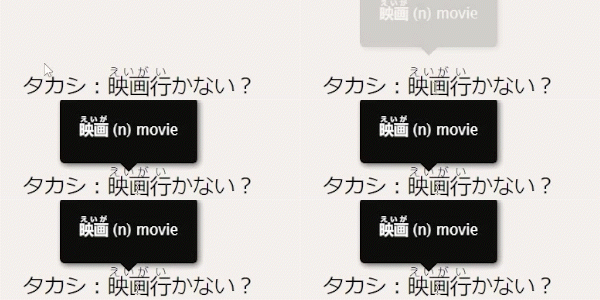
Situation 1
At home, while Ami was cleaning her room, her mother talked to her.
Comprehension Quiz (Skip if you don't understand the conversation yet)
アミの部屋は、____。
A とても綺麗になった
B ちょっと綺麗になった
C 全然綺麗になってない
D この前綺麗にした
母:部屋、綺麗になった?
アミ:いや。まだ、全然…。
母:え!何もやってないじゃん!
アミ:ごめん。マンガ読んじゃって…。
Situation 2
At school, Hiroto is talking with his junior, Rika.
Comprehension Quiz (Skip if you don't understand the conversation yet)
リカは、その先生の名前が分かりますか?
A はい
B いいえ
ヒロト:あの先生の名前、分かる?
リカ:いえ、覚えてないです。
ヒロト:そっか。
リカ:ナオキに聞いてみます?
ヒロト:なんで?
リカ:英語の先生なんで。ナオキの。
Situation 3
During their date, Yuri is talking with her boyfriend, Kaito.
Comprehension Quiz (Skip if you don't understand the conversation yet)
カイトは、何か食べますか?
A はい
B いいえ
ユリ:カフェ入らない?
カイト:いいよ。ここにする?
ユリ:うん。なんか食べる?
カイト:コーヒーだけでいいや。ユリは?
ユリ:私も同じのにする。
Situation 4
Matsui-san is talking with her neighbor, Sato-san.
Comprehension Quiz (Skip if you don't understand the conversation yet)
佐藤さんは、____ショッピングに行く。
A 友達と
B 松井さんと
C 家族で
D 一人で
松井:何するんですか?今日は。
佐藤:ショッピング行ってきます。友達と。
松井:いいですね。
佐藤:松井さんは?
松井:うちで映画観ます。
Step 2 - Take the Quiz
Let's see how many words you remember.
Take the quiz here.
Step 3 - Writing Exercises (Optional)
Let's practice what you learned here.
In Situation 2 when they ask “あの先生の名前、分かる?”
Can 知ってる be used instead of 分かる?
Not in this situation.
(名前)、知ってる?
This means asking if someone has heard the name before and knows it—whether they already have the information.
(名前)、分かる?
This is used when you assume the person may have heard the name or seen the person, and you’re asking if they can recognize or identify who it is, or if they can recall the name from memory.
In this case, the teacher works in their school, so of course they have heard his/her name.
Does it make sense?
I think so. For clarification, 分かる is used with the assumption that the person already knows the information and 知ってる is used when you’re not sure if they know the information or not?
That’s a great observation! And yes, that interpretation is generally accurate, especially in spoken Japanese.
So while 分かる often assumes some familiarity, 知ってる is more neutral — it’s used to check for any level of prior knowledge.
Just as a small addition: 分かる can also be used more broadly to mean “to understand” or “to figure out” something new or unfamiliar, not just something the person is expected to already know.
For example:
When your colleague sees your boss’s indecipherable scribbles and asks:
これ、何て書いてあるか分かる? - Can you read / figure out what this says?
Or when something unfair happens to you, and you say:
なぜこんな目に遭うのか分からない。
– I don’t know why this is happening to me. / I can’t understand why this is happening.
Note:
遭う (あう) – to come across / run into (difficulties or something unpleasant)
Hope it helps. : )
Thank you for the extra explanation and examples! Very helpful!
You’re very welcome! I’m glad to hear that.
Keep up the good work! : )