
Lesson Dialogues
 MP3
MP3
Download Now
* Hover over or tap words to see definitions: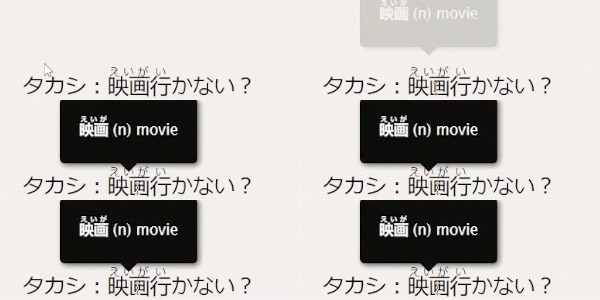
Situation 1
At home, Takeshi and his mother are talking.
Comprehension Quiz (Skip if you don't understand the conversation yet)
タケシは今日、テストがありましたか?
A はい
B いいえ
母:今日、テストあったんだよね?確か。
タケシ:そうだよ。
母:どうだった?できた?
タケシ:うん。思ったよりできた。
Situation 2
At the restaurant, Naoki is talking with his senior, Hiroto.
Comprehension Quiz (Skip if you don't understand the conversation yet)
ヒロトは、ラーメンにしますか?
A はい
B いいえ
ナオキ:ヒロトさん、何にします?
ヒロト:どれにしようかな。ナオキは?
ナオキ:俺、ラーメンにします。
ヒロト:いいね。俺もそれにする。
Situation 3
On a day off, Takeshi is talking with his father at home.
Comprehension Quiz (Skip if you don't understand the conversation yet)
タケシは、____映画に行く。
A よく
B 最近
C 今から
D 一人で
タケシ:友達と映画行ってくる。
父:へー。今から?
タケシ:うん。
父:学校の友達と?
タケシ:そう。
父:何時に帰ってくる?
タケシ:5時くらいかな。
Situation 4
At the company, Matsui-san spoke to her subordinate Suzuki-san.
Comprehension Quiz (Skip if you don't understand the conversation yet)
鈴木さんは、ご飯を____。
A 今食べている
B まだ食べていない
C もう食べた
D もっと食べたい
松井:鈴木くん、ご飯まだ?
鈴木:いえ、もう食べました。
松井:ほんと?じゃ、もうミーティング行ける?
鈴木:行けます。
松井:オッケー。行こうか。
Step 2 - Take the Quiz
Let's see how many words you remember.
Take the quiz here.
Step 3 - Writing Exercises (Optional)
Let's practice what you learned here.
A bit confused about this sentence (and the following answer):
鈴木すずきくん、ご飯はんまだ?
Intuitively I’d read it as “have you had lunch yet?”
And expected the answer to be “yes, I already had/eaten lunch”.
But looking at the translations, it seems like the first question was a negative “haven’t you eaten yet”, and the answer was a negative to that (“no”), which is the same result but just not the most intuitive way to think of it (double negative)..
Can you elaborate?
まだ means “not yet”.
The full sentence should be: ご飯まだ食べてないの?
– You haven’t had lunch yet? / Have you not had lunch yet?
She omits the 食べてないの part.
*
If she meant “Have you had lunch yet?”, she would use もう instead of まだ, and say ご飯もう食べた?
*
In Japanese, responses like はい or いえ typically agree or disagree with the content of the question, not the verb structure.
So when someone asks, まだ食べてないの? (“You haven’t eaten yet?”), replying いえ、もう食べました means “No (I haven’t not eaten) — I already ate.”
It sounds contradictory in English logic, but it’s completely natural in Japanese.
This was a piece in my learning path that I was missing. Have been learning for a month a half and know my hiragana and katakana but grammar, vocabulary and kanji still very limited. Love this method.
ありかトウ誤差います!
Thanks! Glad you found this course!
Thank you for this platform! I’ve been studying Japanese for a few months and know basic grammar, but my vocabulary is still quite limited. These exercises help me review what I’ve learned and learn new things. For example, I didn’t know how to use より, so I’ll study this particle next. I really like this approach – learning new things while practicing what I already know. I hope it will really help me make progress. Thank you again! ありがとうございます!
Thanks! I hope this course will take your Japanese to the next level!